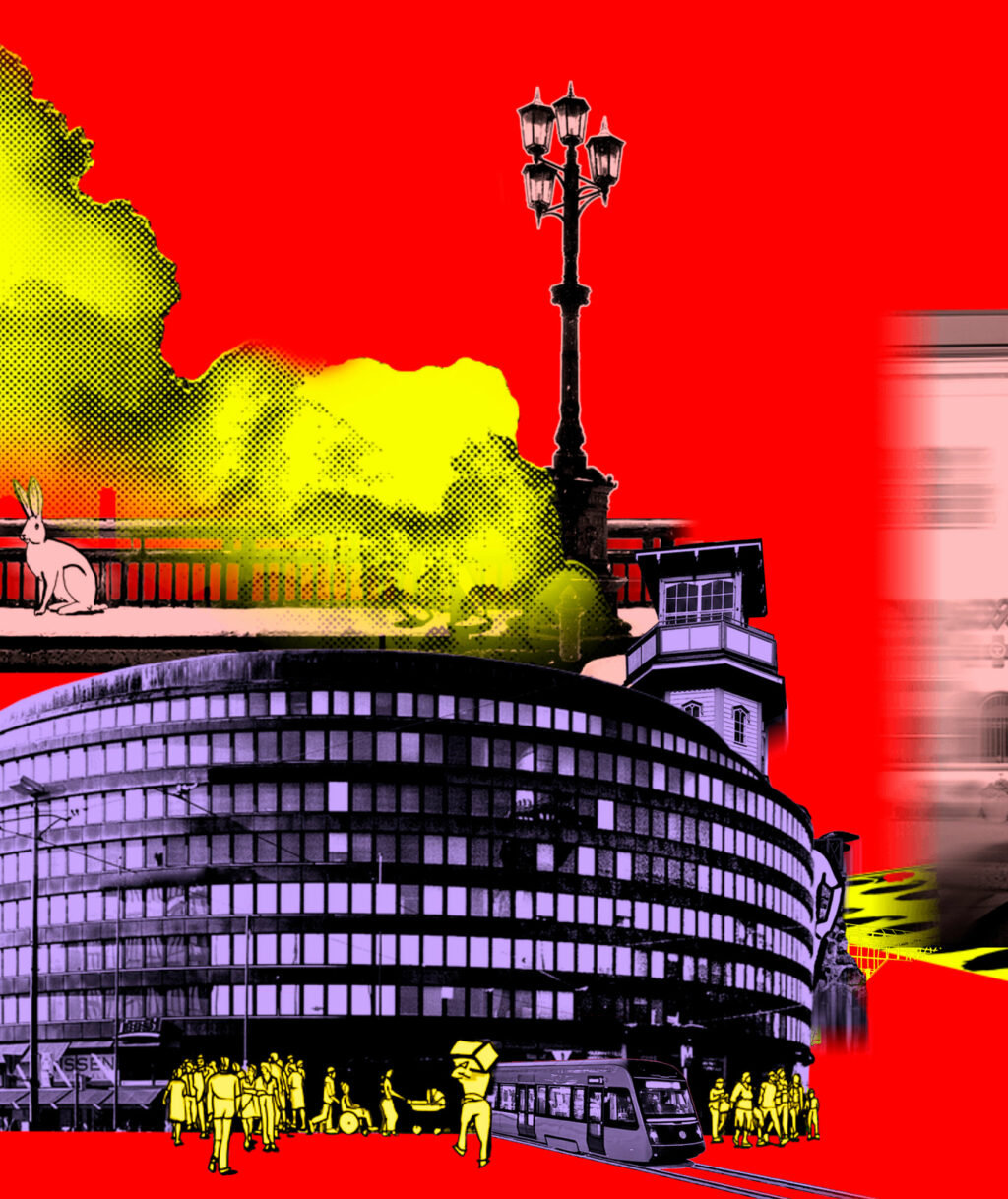
The artists for the Art Realm ’26 Biennial were published on 6 March 2026.
By location
Finlayson Area
-
Raisa Foster (b. 1976) is a Tampere-based artist and docent in dance education and social pedagogy whose recent artistic practice has centred on issues of eco-social justice and sustainable ways of living. In her work, Foster foregrounds embodiment and movement, interwoven with digital media. She creates works that stimulate the senses, evoke emotion, and raise awareness.
The Work of Art in the Age of Non-Production is a participatory performance that unfolds in a setting with a distinctly urban identity – a city park. It explores themes of co-creation, connection, and imagining the future, offering participants the opportunity to attune and engage with the work through their own relationships with their environment. The work unfolds as a bodily practice of observation, presence, and sharing, rather than one of production, ownership, or critique. The performances will be staged on July 8 and July 10, starting at 3:00 p.m.
-
Kyllikki Haavisto (b. 1957) is an Orimattila-based painter who primarily works with oils, using pigments she grinds herself. She often combines oil painting with other adapted techniques that support the concept of the work.
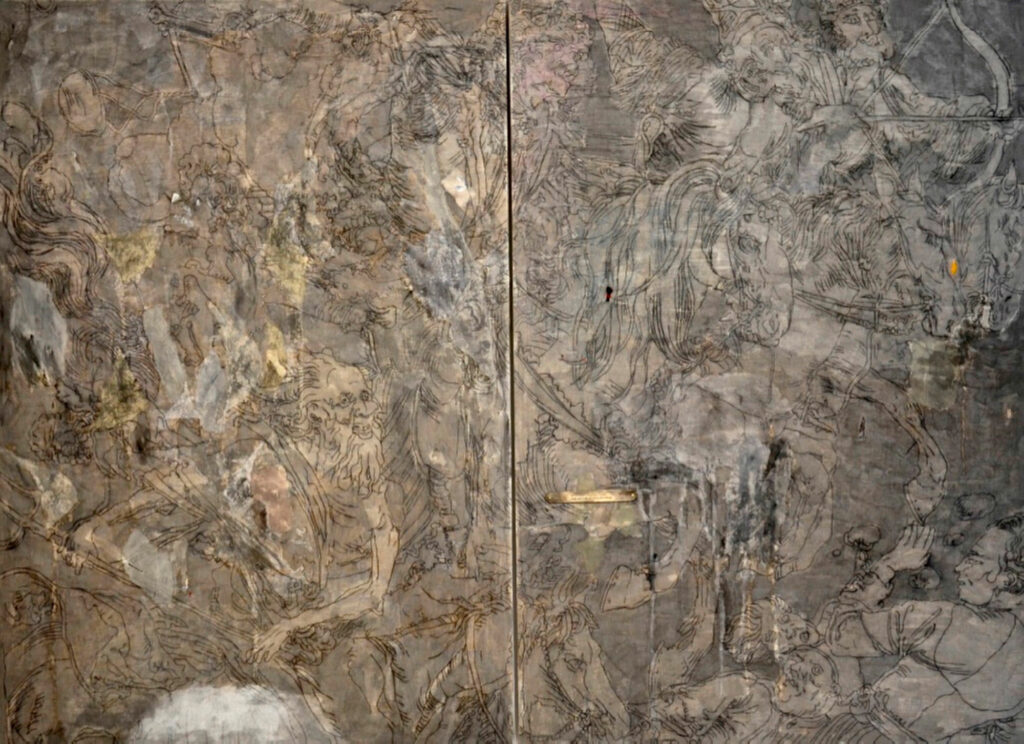
This fusion of techniques holds particular significance in the painting Run, Wild Child (Hommage à Dürer). The work is executed in liquid charcoal on a golden map of Europe, in the style of a cave painting. It depicts Attila and his Hunnic forces in the form of four horsemen and accompanying soldiers. Suggesting a fragment of a larger scene, the pictorial surface is filled with movement and intensity. Haavisto’s drawing style is reminiscent of Albrecht Dürer’s graphic work in its refined and nuanced handling of line. The painting is a conscious tribute to Dürer, echoing his woodcut The Four Horsemen of the Apocalypse (1497–1498).
-
Eeva Honkanen (b. 1983) is a Lahti-based artist known for her large-scale ink drawings. In her practice, she combines personal and historical imagery with surreal juxtapositions. Her work is rich in detail, engaging consciously with excess and exaggeration.
The monumental ink drawing Trapped in Time depicts a human figure in profile in the lower left corner of the composition, while a swirling flood of intertwined motifs cascades in its wake. The work explores the paradox of overidentification with the mind. Humans often perceive themselves as distinct from other species, particularly through their capacity for thought. In Honkanen’s drawing, time and mind are presented as inseparable; to identify with the mind is thus to become bound to time – confined to memory and projection. Past and future collapse into one another, resulting in a diminished capacity to inhabit the present. The mind-identified subject acts unconsciously, losing sight of the fundamental interconnectedness of all human beings and the surrounding world.
-
Juhani Koivumäki (b. 1981) is a filmmaker and media artist who holds master’s degrees in fine arts, theology, and Buddhist studies. He approaches both art and religion as avenues for exploring the human condition and the depths of the mind.
Poverty Saves is a short film shot and directed by Koivumäki. Between 2021 and 2025, he recorded footage of the performance artist Pentti-Otto Koskinen in Helsinki, Tampere, Vilnius, Istanbul, and Konya. Within spiritual and mystical traditions, poverty can be understood as an ideal mode of being, in which the individual is freed from all worldly attachments. On a personal level, however, poverty is often experienced as a stigmatising condition through which people judge one another. It may also be seen as an ecological, anti-consumerist stance. Koivumäki’s film reflects on these conflicting understandings of poverty: a spiritual and existential ideal on the one hand, and on the other, a narrow economic logic that defines human worth in terms of wealth.
-
Marko Lampisuo (b. 1970) is a Tampere-based artist known for his media works, printmaking, and site-responsive installations that explore themes related to the environment, family life, and aesthetics.
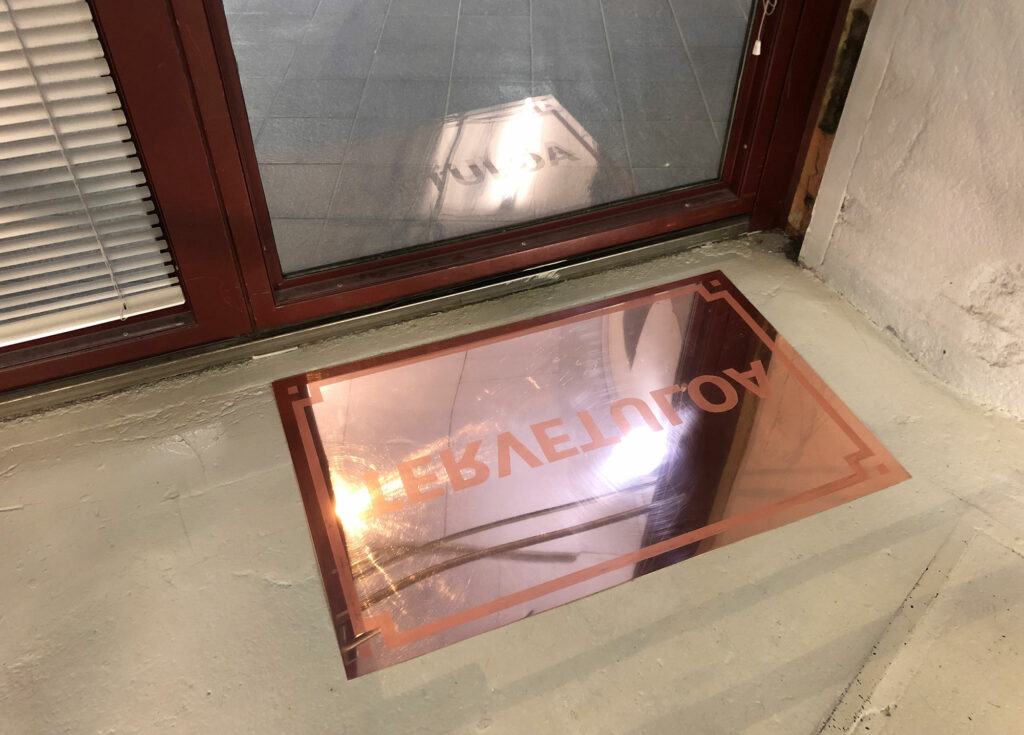
Welcome is a body of work consisting of a copper plate installed as a doormat at the entrance to the Finlayson exhibition space, along with prints pulled from it both before and during the exhibition. The plate was previously placed at the entrance of the Himmelblau Printmaking Studio, where Lampisuo works as a master printer. The studio’s customers, artists, and printmakers have already left their marks on the plate – and on the prints pulled from it. As biennial visitors step onto the plate upon arrival and departure, they too leave their traces: new scratches and indentations that are subsequently recorded in the prints. Welcome is an open-ended artistic process that reflects on hospitality, reciprocity, and the complexities of working together.
-
Laura Lappi (b. 1979) is a sculptor whose reliefs and site-specific installations draw inspiration from architecture, as well as from her explorations of the history and geography of spaces and places. Her works inhabit a hazy borderland between reality and fiction.
Aenigma belongs to a series of reliefs inspired by the mysterious splendour and mysticism of old European basilicas and cathedrals, as well as Scandinavian wooden architecture and floor plans. Constructed from small fragments of recycled wood, the dark-toned abstract wall sculpture evokes architectural features of historic buildings. Working sustainably with natural materials is integral to Lappi’s practice. The sculptures are made entirely from recycled wood and treated using natural methods. Rather than applying paint, Lappi employs the ancient Japanese yakisugi wood-preservation technique, in which the surface of the timber is charred. Different types of wood burn in distinct ways, producing varied and nuanced textures. The way the surfaces catch and reflect light is also significant.
-
Eeva Peura (b. 1982) explores narrativity and communication through painting. For her, art is a way of connecting with people and with the world. The fleeting impulse behind a work often leads somewhere quite different from where it began as the process unfolds. For Peura, painting is an exploratory journey with an unknown destination, as well as a distinct form of communication – a language composed of layered colour, pigment, shifting hues, and nuanced variations in brushwork. At the heart of Peura’s practice is the challenge of giving form to an evanescent thought: something initially formless, strange, and not yet fully ripe. Her work engages with aspects of the visible world that seem strangely foreign to human experience – what it is to live, and what it feels like to be human.
The paintings in this exhibition bring together motifs that have recurred in Peura’s recent practice, here appearing in new combinations: gardens, internal organs, plants reflected in water, soldiers, feathers, starry skies, ancient scholars, rippling water, and an abundance of painterly detail. The fluidity of water and the organic shapes of flowers echo dimensions of inner human experience, creating visual metaphors for states of being that are otherwise difficult to articulate.
-
Inari Sandell’s installation examines the flight paths of butterflies, challenging conventional ideas of “normal” movement and cognition. Combining video essay, photography, and sculpture, the work draws parallels between the seemingly erratic flight trajectories of butterflies and the diverse ways autistic minds and bodies move and conceptualise the world. What may appear random or chaotic to humans is, for the butterfly, a survival strategy. Sandell presents the butterfly as a symbol of resistance to cognitive and bodily norms, suggesting that divergent ways of thinking and moving are logical, valuable, queer, and intelligent systems in their own right.
Helsinki-based Inari Sandell (b. 1991, Lahti) is a multidisciplinary artist working with images, space, and materials. Her practice is informed by a personal engagement with themes related to neurodiversity.
-
Hanna Oinonen (b. 1971) is a Tampere-based artist known for working with ephemeral, recycled, or “worthless” materials. She employs a range of craft techniques to create site-specific temporary installations that evoke immersive, atmospheric worlds.
The Monument is a collage-like installation made from chocolate wrappers and cigarette rolling papers collected by the artist over decades. Over time, these wrappers have come to hold cherished memories of moments shared with friends and strangers – in cafés, bars, homes across different cities. After the chocolate is eaten and the cigarettes smoked, Oinonen records the time, place, and people present on the wrappers through writings and drawings. These intimate repositories of memory come together to form a monumental collage on the exhibition wall.
-
Based in Tampere, Pauliina Parjanen (b. 1987) primarily works in sculpture, often employing ceramics as her medium. Her practice reflects an interest in contradictions, subcultures, and the meanings inherently embedded in materials.
Landscape Study is a ceramic installation composed of everyday objects – familiar to all – yet rendered in an unexpected material. The work playfully examines our assumptions about materials, prompting the viewer to reflect on how accustomed we have become to seeing plastic everywhere. Items such as garbage bags and white plastic chairs are so ubiquitous, ordinary, and so seamlessly integrated into our surroundings that they often go unnoticed. Only upon closer inspection does the viewer realise that these objects are not made of plastic, but of fired clay.
-
Pilvi Takala (b. 1986) primarily works in video and performance. Her practice is driven by a fascination with normative social structures, often emerging from close study of specific communities, including the security industry and office environments. By placing herself in challenging social situations, Takala interrogates the unwritten rules that govern these spaces, making them visible to the viewer.
Feeling Defensive (Part 1) emerged from Takala’s experience attending Finland’s National Defence Course – a programme organised by the Finnish military to foster support for national defence among influential social figures. Takala was invited to participate in the 2024 course, whose motto is “Security Together”. In the video, she and fellow participant, political scientist Johanna Vuorelma, discuss and analyse how the course sought to shape their perspectives. The Tampere-based sound designer Pinja Mustajoki was a member of the production team. Feeling Defensive (Part 1) has previously been shown at Kunstraum Bethanien in Berlin, the Docpoint Film Festival in Helsinki, and at the International Film Festival Rotterdam.
-
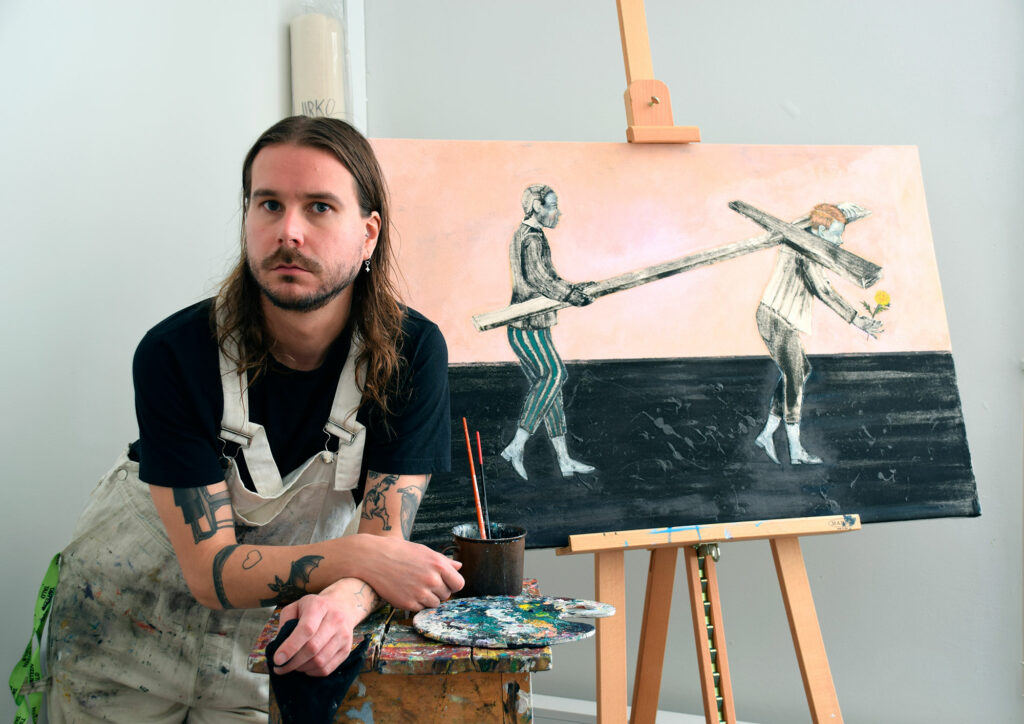
Turku-based Jirko Viljanen (b. 1991, Lahti) describes himself as an experimental printmaker who boldly combines multiple techniques. Mental health struggles and reflections on mortality recur throughout his recent work, which draws on surrealist and symbolist sensibilities. The pieces selected for the biennial explore human imperfection and the acceptance of frailty, filtered through the logic of dreams.
Viljanen works in layers. His signature technique begins with printing a canvas using traditional printmaking methods, then overlaying other media, such as paint. Unlike typical print editions, the resulting monotypes are each unique. Through his practice, Viljanen seeks solace and serenity in melancholy, making peace with sadness and engaging in an ongoing search for his deepest self.
The figures in the stop-motion animation The Boy from Ward Five are simultaneously endearing, raw, and flawed, serving as metaphors for life’s ceaseless vicissitudes. The semi-silent short film embraces a DIY aesthetic, responding to the rise of artificial intelligence while celebrating human frailty and imperfection.
-
Jenny Vesiväki (b. 1986) works across painting, mixed media, and performance. She describes herself as a topophile – a lover of places. At the core of her practice is a profound recognition of the interconnectedness of all things in existence.
Consultation Session for Imaginary Solutions (2025–) is a participatory performance in which Vesiväki assumes the role of an on-call consultant, offering exhibition visitors imaginative solutions to everyday problems, practical dilemmas, and unanswered questions. Visitors receive a “prescription” from the artist that provides a fresh perspective and playful approach to their challenge. Vesiväki believes that many of our difficulties stem from overreliance on logic; by letting go, embracing play, and engaging with unexpected encounters, we can open new avenues of thought. Consultation hours are on June 24 and 25, from 2:00 to 5:00 p.m.
-
The core theme of Camilla Vuorenmaa’s (b. 1979) practice is the experience of the individual and human engagement within a group. She works primarily with painting, carving on wooden panels, and installations composed of multiple paintings. Her murals reflect a fascination with the relationship between artwork and space, the ephemerality of perception, and the interplay between wall texture and painted surface. Often drawing on photographs as source material, Vuorenmaa has recently expanded her practice to include UV-fluorescent paintings and media art.
Vuorenmaa’s mural Loved Ones revolves around the theme of family ties. The work was inspired by old photographs of blood relatives, images of the artist’s cousins, aunts, and uncles found on social media, as well as photos of her chosen rainbow family and close friends. Loved Ones explores the dynamics between intimate and distant familial connections and reflects on the broader concept of kinship itself.
Artist pair
-
Designer and artist Helmi Remes (b. 1983) and visual artist Panu Ruotsalo (b. 1971) have collaborated on a four-part series of sculptural works for the biennial. Remes’s practice moves between abstract sculpture and product design, with glass as her primary material. Ruotsalo, in turn, is a painter known especially for his abstract expressionist works.
Their collaborative series – Anatomy of Longing I–III and Openings – brings together abstract form, kiln-cast glass, and charred solid wood. The dark-toned sculptures are composed of slender, arching elements that lean into one another, their surfaces traced with delicate linear patterns created from white glass rods.
Artist groups
-
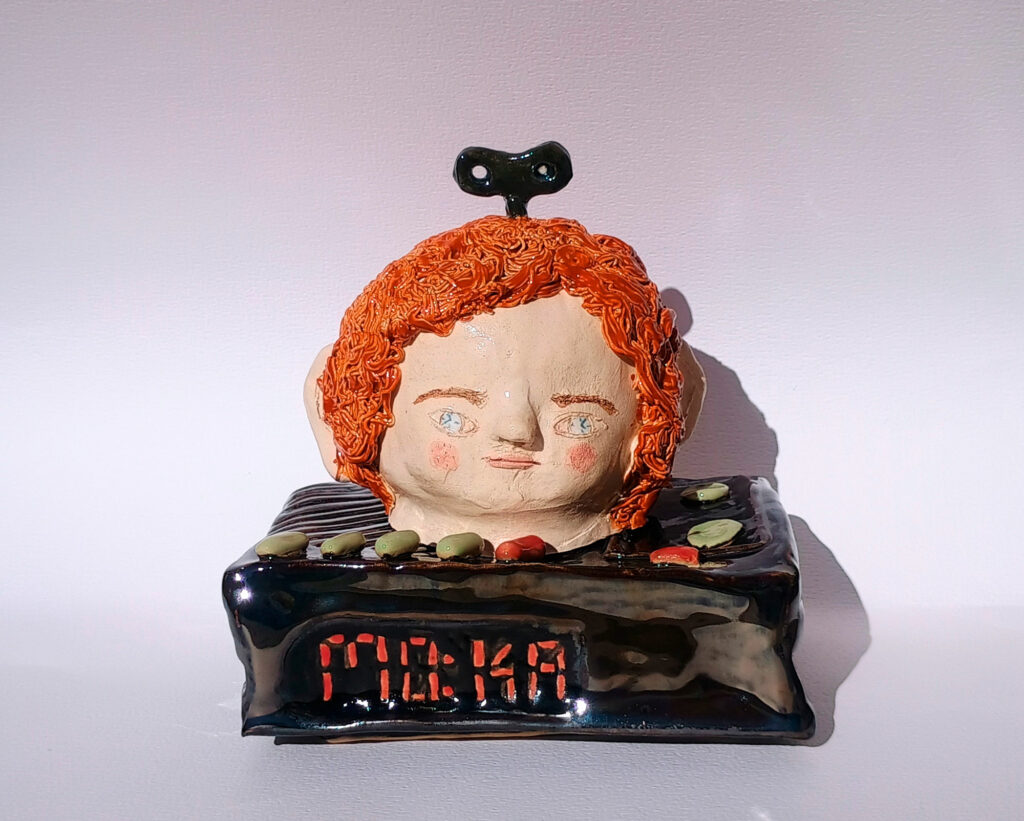
MOKA (literally “blunder” in English) is a collective of seven artists – Senni Aleksandra, Timo Höyssä, Ilai Elias Lehto, Paananen & Ulvila, Sanna Saarreharju, and Liisa Tarleena Öhman. Since 2022, they have collaborated creatively, exploring human foibles from multiple perspectives, both within their artistic practice and personal lives.
For the body of work presented at the biennial, the artists collected stories of personal blunders, which contributors shared anonymously. This act functioned as a kind of confessional: releasing embarrassing gaffes and shameful slip-ups into the collective consciousness offered a sense of absolution. The collective then distilled and curated fragments of these confessions, archiving them within a “museum”.
The installation takes the form of an “exhibition within an exhibition”. The MOKA Museum occupies its own cohesive space, presenting everyday sources of shame, personal disasters, and the errors of an entire nation in a tangible, physical form.
-
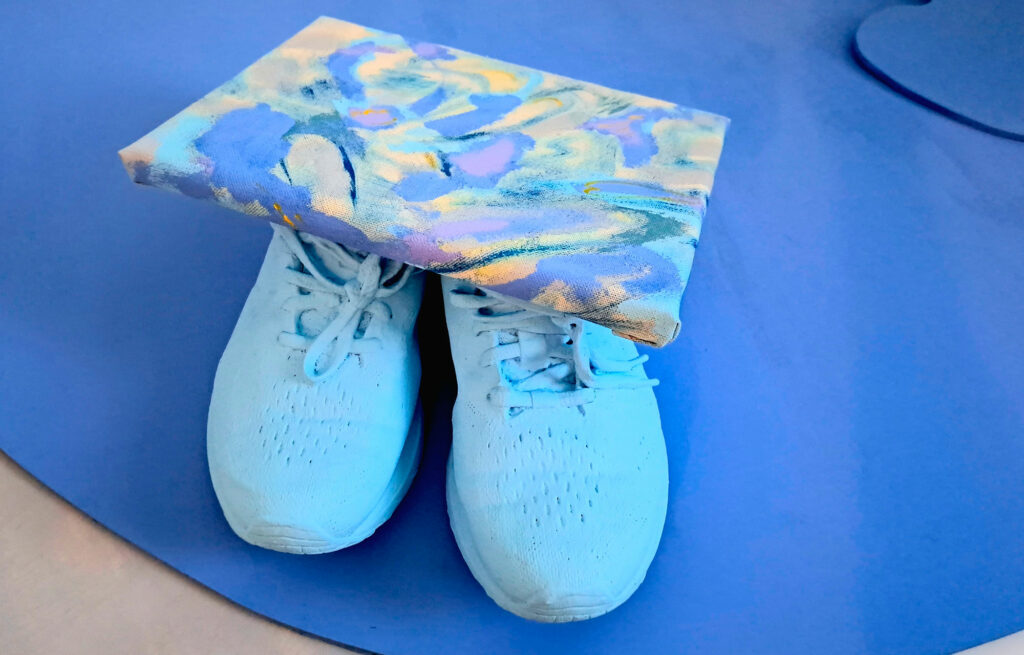
Transition Zone is an installation created collaboratively by Anna Hyrkkänen (b. 1979), Katri Mononen (b. 1981), and Mia Saharla (b. 1983). Resembling a stage set, it forms an environment of paintings, sculptures, and other three-dimensional elements, further activated by light effects and video projections. The work extends the group’s collective practice to a point where individual authorship is relinquished in favour of shared processes shaped by chance and contingency.
As its title suggests, the installation can be understood as a liminal space and site of transformation. It also draws on the natural sciences: the transition zone is a geological term referring to the layer between the Earth’s upper and lower mantle. During the exhibition, the artists will transform the installation three times through performative interventions. Visitors are invited to attend and witness the emergence of new meanings on June 18 at 12:00 p.m. and on August 7 at 4:30 p.m.
-
Edwina Goldstone, Henri Hakala, Joni Jääskeläinen, Eveliina Korlee, Sam Laurila, Daniel Lehtinen, Linnea Meuronen, Joonas Mäkinen, Ville Penttilä, Artturi Puskala, Vesa Rimpilä and Lasse Rinne
Over the past winter, Edwina Goldstone has collaborated with artists participating in the OmaPolku programme for artists with special needs. Using printmaking techniques, they created a collective artwork exploring the concept of happiness and what it truly means. The Garden of Forgotten Happiness invites us to reconsider happiness through the lens of ordinariness, equality, and shared making, while also questioning the traditional hierarchies that determine whose voices are heard in the art world.
The work consists of intaglio prints on food packaging. The “garden” functions as a metaphor for the mind – a place where hope is cultivated and the future reimagined.
The collaboration was supported by OmaPolku’s art directors Jenni Koivurova, Leena Lehti, and Tiia Viiltola. The project was coordinated and supported by the Kettuki Association. -
Hyäryllistä is a collective of three visual artists: Jouko Korkeasaari (b. 1971), Sari Koski-Vähälä (b. 1968), and Heli Kurunsaari (b. 1971). In their collaborative practice, the perspectives, ideas, and strengths of the three artists become organically intertwined. Reusing parts and materials from earlier works, their approach combines slow, hands-on making with an openness to chance and surprise, through which unexpected discoveries emerge. The collective held its first joint exhibition in 1992.
An Attempt to Clarify a Confusing Situation II is an expansive installation that combines mixed-media sculptural forms with scaffold-like structures constructed from the red-ochre planks of an old fence. The work’s title evokes our existence in a once-familiar world that has suddenly turned upside down, compelling us to confront and reinterpret our situation anew each day.
Haihara Art Centre
-
Piia Rossi’s practice unfolds through cycles of transformation and memory, often exploring the tension between fragility and durability, decay and renewal. Her visual language is grounded in slowness, attentive observation, and the gathering and processing of materials. This measured rhythm mirrors the passage of time, making her process visibly present within the work.
For the biennial, Rossi has created a collective piece that engages with traces of individual and communal imagination. The work consists of porcelain cups formed by Rossi, onto which contributors have inscribed their words and thoughts, interweaving their collective gestures with the artist’s personal handprint. Trace thus becomes both a physical and spiritual experience, reminding us of the power of shared imagination. It invites viewers to consider how every thought and action leaves an imprint capable of shaping what is to come.
-
Based in Mänttä and Tampere, Janne Laine (b. 1970) works at the intersection of photography and printmaking. He approaches landscapes as subjects that resist being anchored to a specific location or judged by standards of authenticity. His images are deliberately universal, eluding recognisability. Laine travels with his camera to gather source material, which he later transfers onto etching plates using photographic exposure techniques. The acid-etching stage is the only point at which he manipulates the image. He may introduce colour through aquatint or, occasionally, the chine-collé technique. Laine prints the works himself, and his background as a master printer is evident in the exceptional technical precision of his oeuvre.
Over the years, Laine has worked on numerous collaborative projects with colleagues from various disciplines. Layerings extends this collaboration to the public. Children and adults alike are invited to draw or write directly onto the black-and-white prints mounted on the walls, and to sign their contribution. Once a print is filled, the artist replaces it with a fresh image, and the process begins anew.
-
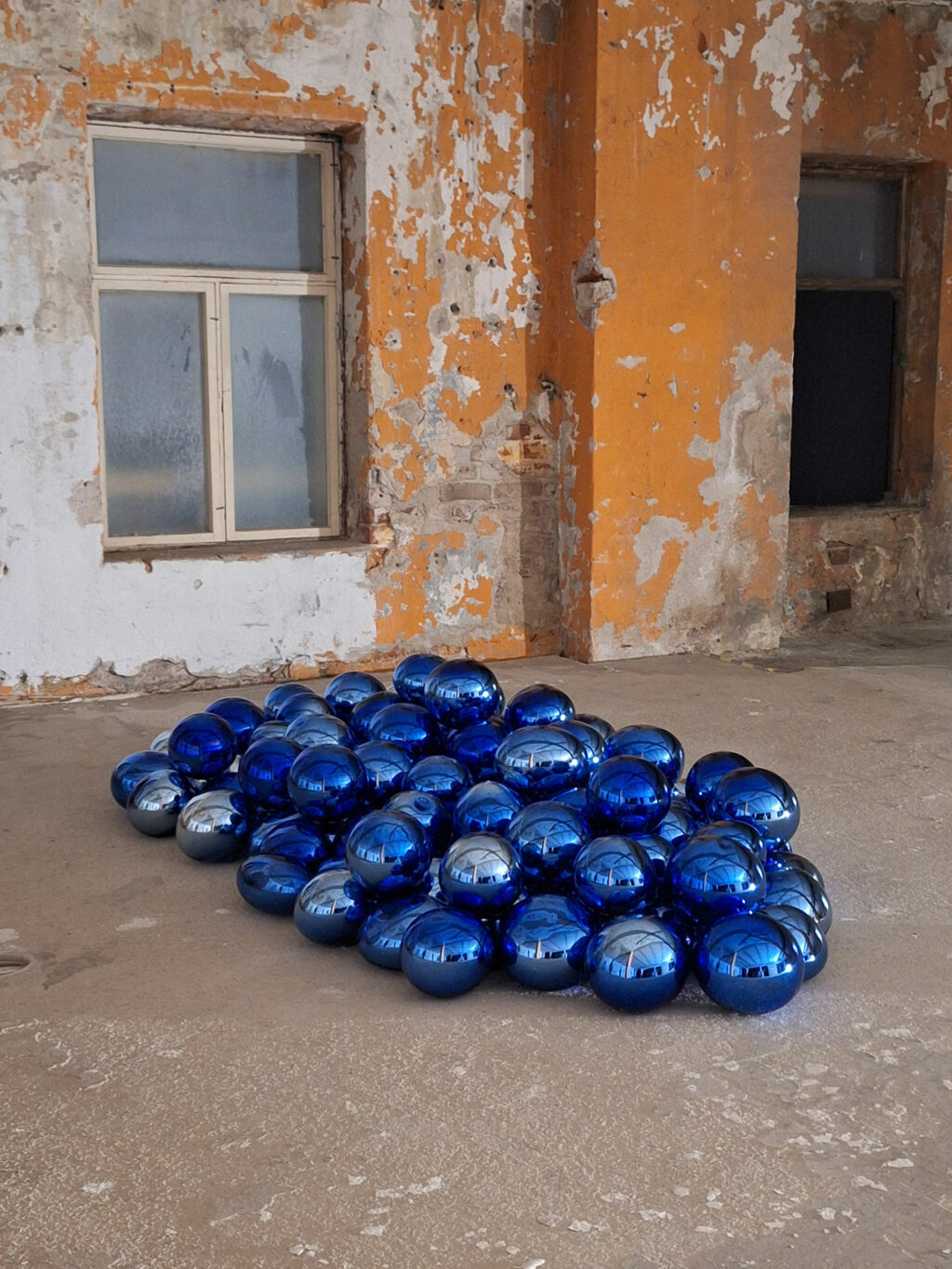
Based in Nuutajärvi, Janne Rahunen (b. 1987) specialises in unique glass sculpture, which he handcrafts and often presents as large-scale installations.
Many of Rahunen’s works speculate on possible future scenarios. Finished with reflective surfaces created through mirroring techniques, the sculptures invite viewers to confront the ongoing tension between nature and human progress. We speak of protecting and living in harmony with the natural world, yet the environments we construct are increasingly polished, sterile, and removed from nature. Seeking comfort and efficiency, we shape surroundings that prioritise only human needs.A pirunpelto – literally “devil’s field” – is a Finnish term for vast expanses of boulders left behind as Ice Age waters receded and eroded ancient shorelines. Rahunen’s Pirunpelto is a 120-part glass installation that throws the viewer’s image back at them, as if offering a glimpse into a future we may be in the process of creating.
-
Carrying 5,867 dairy cows, the cargo ship Gulf Livestock 1 set sail from New Zealand bound for China in August 2020. When Typhoon Maysak struck the coast of Japan on September 2, the ship sank. Of the more than forty crew members, only two were rescued. All 5,867 cows drowned.
Homage to 5,867 Cattle is an eleven-day performative installation in which Siina Levonoja moulds a collection of miniature cows from clay. The work invokes the value and rights of farm animals, functioning as both a repentance exercise and a mourning ritual for the drowned cattle.
The installation is participatory: the public is invited to join the artist in sculpting clay cows during the performance, which runs from June 13 to 28 during exhibition hours.
The multifaceted practice of Helsinki-based Siina Levonoja (b. 1982, Sastamala) encompasses sculpture, installation, and performance. Her works often explore cross-species encounters, multispecies coexistence, and the complex relationships between humans and other animals.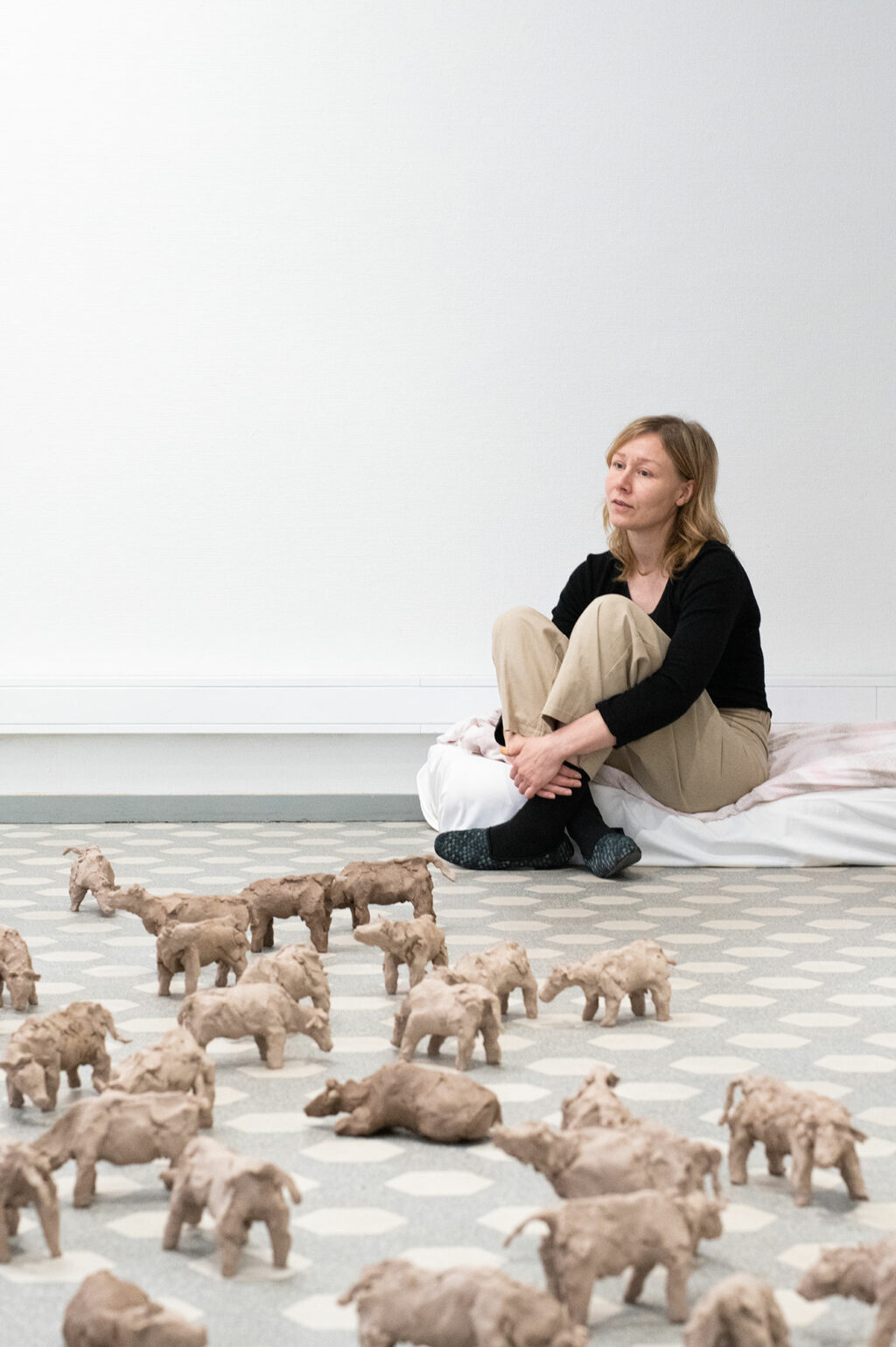
-
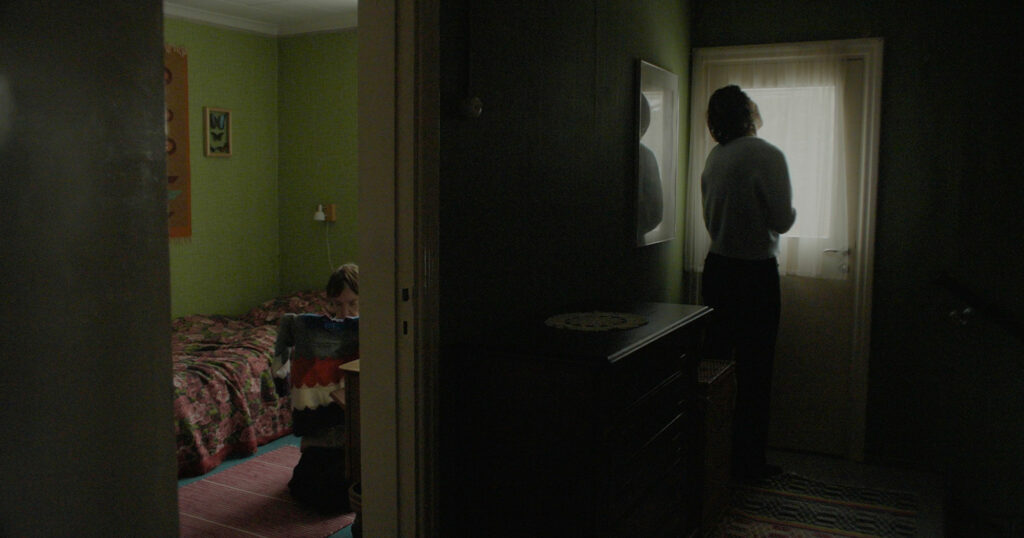
The work of Helsinki-based film director and media artist Rosaliina Paavilainen (b. 1993, Tampere) lies at the intersection of fiction, documentary, and video art. She approaches her subjects through personal experience and close observation of everyday life. Recurring themes in her work include intimacy, family relations, shame, and the ways in which people construct narratives about their own lives.
Seidi Haarla and Sue Lemström appear in the film, which depicts an elderly woman awaiting one final encounter with a loved one before her death. The arrival of a younger woman lends the situation a tangible sense of inevitability. The work reflects on death as a threshold beyond which the past can no longer be reshaped. Remorse and the hope of reconciliation emerge in the space between two people, both in what is spoken and what remains unspoken.
-
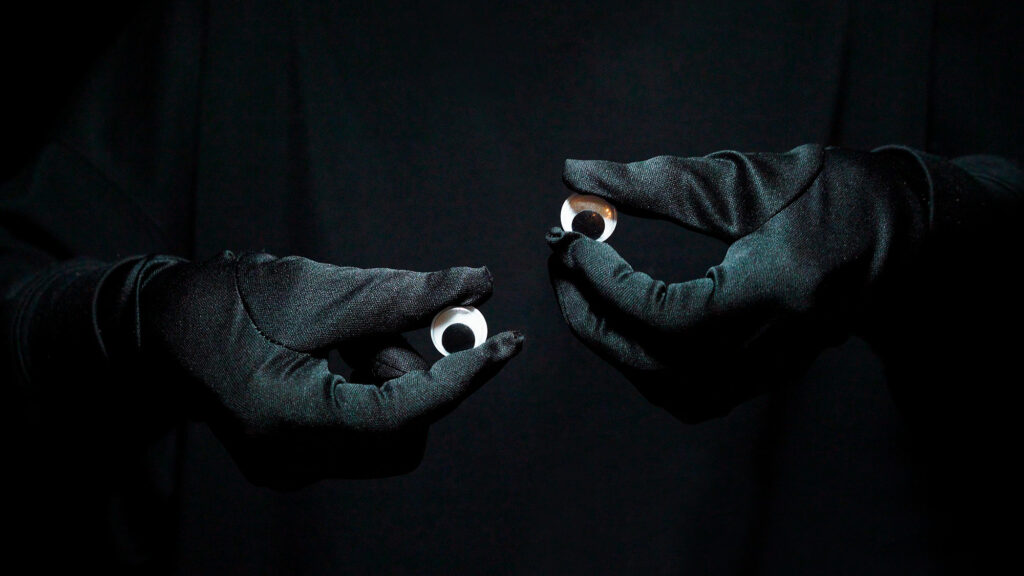
Vilma Pimenoff’s media work explores multiple perspectives on the meaning of life, offering subtle reflections and guidance on what it means to be human. Drawing on documentary audio material, her work is edited and dramatised into a video installation. The narrative approach is experimental – at times bordering on the absurd – yet the result extends beyond comedy into something more contemplative. Trust and friendship emerge as central themes, underscoring their vital role in survival, transformation, and renewal.
Based in Helsinki, Vilma Pimenoff (b. 1980, Sastamala) works across photography, video, text, and installation. Her practice investigates human-constructed notions of life and existence, while also examining how images shape our understanding of truth and reality. Through her work, she reflects on how we navigate and make sense of the world through signs and symbols.
-
Sanni Seppä’s works are almost always autobiographical. Their latest watercolours capture everyday moments intertwined with the harsh realities of the contemporary world. Intimate emotions – love, security, and care – intersect with broader societal concerns, reflecting on what is being lost and destroyed globally: people, animals, and the natural environment alike.
Seppä’s precise, observant style emphasises accessibility. Their subjects – animals, friends, objects, and landscapes – are rendered exactly as they appear, anchored firmly in the present moment, making the work immediately relatable.
Sanni Seppä (b. 1980) is a non-binary visual artist and activist based in Tampere. Working across acrylic painting, sculpture, installation, and public art, they champion equality, community, and interpersonal anarchy, with a particular dedication to supporting the rights of animals and marginalised groups through their artistic practice.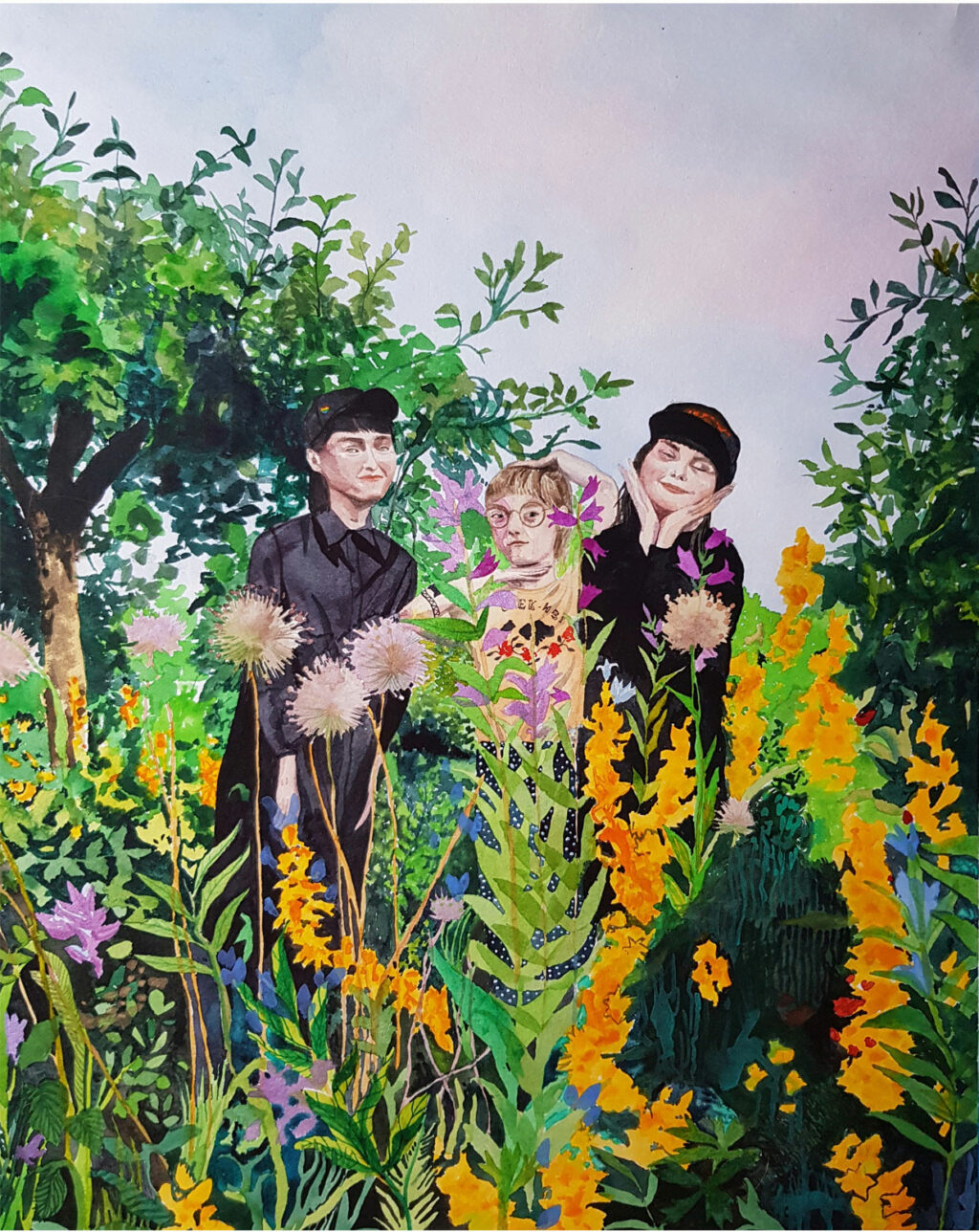
-
Born in Parkano, Jari Silomäki (b. 1975) has worked within the field of narrative documentary photography for twenty-five years. His practice draws on performative strategies, often reinterpreting situations with an emphasis on context and subjectivity.
Album of Uncertainty is a personal, fragmentary, essay-like body of work that explores human sensitivity and the experience of uncertainty. Three parts from the series are presented at the Art Realm Biennial ‘26. In portraits of newly infatuated couples, Silomäki captures relationships at a stage when feelings are scarcely spoken aloud. Early love appears not as a space of security, but as a state in which euphoria is intermingled with unbearable uncertainty. Pages From One’s Youth pairs diary entries with images of other-than-human beings, whose existence is defined by constant vigilance and acute sensitivity to their surroundings – where danger is registered in the body before any visible cause emerges. The series concludes with Gradient, in which the repeated inscription “I love my loser’s identity” on rag paper forms a gradual tonal shift through repetition.
-
Maria Stereo (b. 1979) embraces a style of decorative opulence. Working frequently with recycled and broken porcelain and ceramic objects, she deliberately shatters them and reassembles the fragments into composite sculptures and mosaic-like reliefs. Her process balances anarchy with meticulous craftsmanship.
Shaped like a rose arch, For You is composed of shattered tableware sourced from thrift shops, hand-painted decorative plates, and fragments of figurines. Congratulatory messages, initials, dedications, dates, and other markings remain visible on the surfaces. Through the work, Stereo reflects on the objects’ unknown former owners and their stories: “They have painstakingly decorated the rims of dishes, sipped coffee from signed cups, and presented porcelain figurines as gifts to someone special. These thoughts inscribed on the surfaces of inanimate objects feel warm and deeply human.”
Stereo works intuitively, building her structures through spontaneous combinations of patterns and colours. Her visual language draws on influences from Rococo, kitsch, and surrealism. Cuteness and reverie are tempered by melancholy reflection, while undercurrents of mysticism and symbolism open the work to multiple interpretations. -
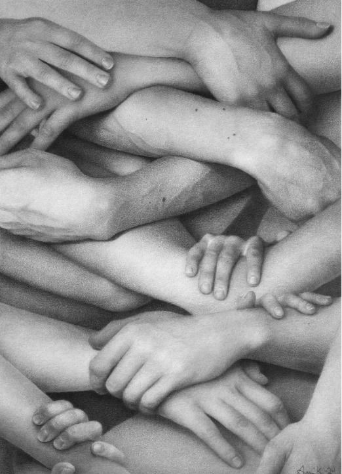
Anni Takala (b. 1990, Lahti) – known by her artist name Anni Kristiina – is a Savitaipale-based artist whose practice centres on drawing and printmaking. Her works are understated, depicting anonymous human figures in undefined settings that offer no clues as to time or place. Through representations of the human body, she explores universal human experiences, emotional states, and paradoxes. Her works are rich in symbolic nuance and intricate detail, often carrying a subtle surreal quality.
For the Art Realm Biennial ‘26, Anni Kristiina presents a series of drawings that emerged spontaneously, without a predefined theme, yet together form a cohesive body of work. Hands are a recurring motif – both holding on and reaching out.
In her recent practice, the artist has explored various forms of reciprocity: the relationship of humans to themselves, as well as the dialogue between humans and nature. Metamorphosis often plays an integral role in her work, in which humans merge with nature and the real intertwines with the surreal.
-
“Mielikki, the wife of Tapio, the god and ruler of the forest, is charged with protecting the woods and preserving their beauty. Her Guard – a loyal company of royal bodyguards – accompanies her wherever she goes. Whenever the Guard appears, Mielikki is present among the people, carrying out her duties. Now, angered by the relentless destruction of natural forests, she has taken to the warpath.”
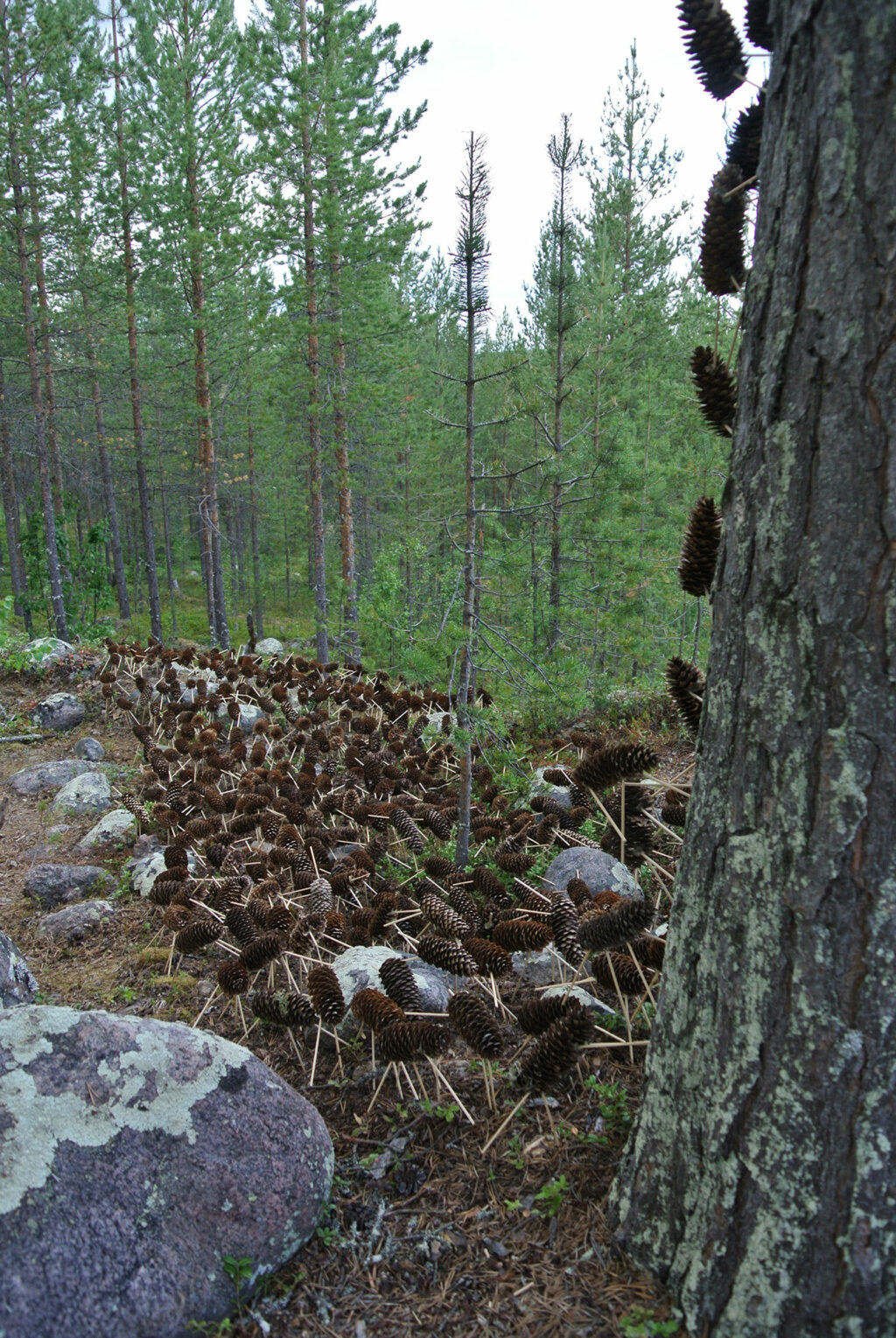
Tiina-Liisa Kaalamo (b. 1988), who works under the artist name Tiina-Liisa/Tisainia, is a Lahti-based artist whose practice centres on recycled and natural materials. Deeply inspired by nature, she is committed to its preservation. Her installation currently on display in Haihara Park is the third iteration of Mielikki’s Guard, which consists of a herd of hundreds of stampeding cattle crafted from pine cones and sticks. The pinecone herd has previously thundered through an environmental art exhibition in the village of Oranki in Lapland, as well as an urban art exhibition in Lahti in 2024.
Artist pairs
-
“I live, breathe, and grow in silence.”
“Trees are more important for life on Earth than humans. They communicate in many ways. They are our friends – and we would do well to listen to them,” state Helinä Hukkataival and Ida Sofia Fleming. Their collaborative project Voice of a Tree – Voice of a Friend is a site-specific, participatory sound piece and performance staged in the courtyard of Haihara Manor. The work channels the voice of a century-old spruce, initiating a dialogue between the tree and the viewer. This shared encounter draws attention to the things we cannot normally perceive with the senses, yet alongside which we coexist – including the hidden layers within ourselves. The performance will take place beside the spruce on June 17 and August 6 at 1 p.m.
Helinä Hukkataival (b. 1941) is a visual, performance, and media artist whose work is shaped by a lifelong engagement with Zen philosophy and visual minimalism.
Ida Sofia Fleming (b. 1990) works across sculpture, video, and photography, and is particularly known for her large-scale works incorporating rusted metal sheets.
-
The collaborative sculptures by Tampere-based artist Jesse Kitinoja (b. 1995) and his uncle, Seinäjoki-based woodcarver Macu Makkonen (b. 1944), draw inspiration from humanity’s relationship with nature, environmental concerns, and mythologies – infused with a subtle sense of mischievous humour. The artists aim to evoke a sense of wonder in the viewer.
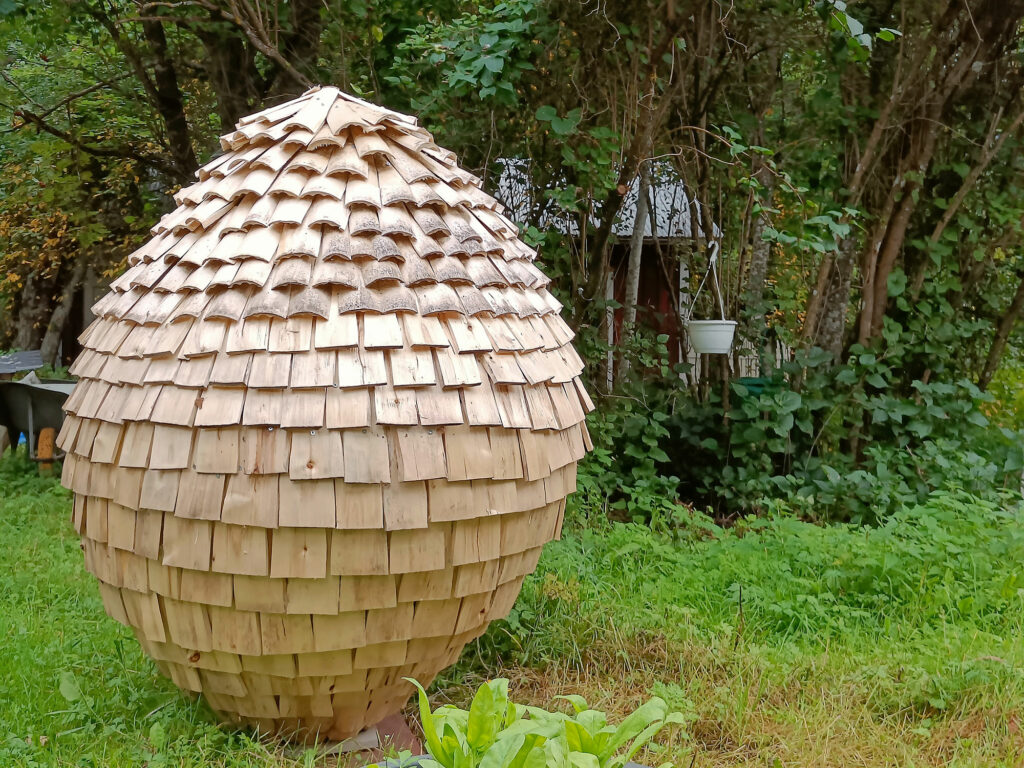
Presented in Haihara Park, Lumber Camp invites the viewer into an imaginative landscape: what kind of forest might contain pinecones of such immense scale, and what creatures might feed upon them? Could the knotholes in the branches be entrances to dwellings? The installation is composed of shingles and scales carved from aspen logs felled by Makkonen.
Kitinoja works across sculpture, installation, and public art. His practice explores human experiences of time, place, and space, often drawing inspiration from the context of the work as well as broader environmental themes. Makkonen is a highly versatile woodcarver and master of timber construction. He served as master instructor in student workshops at the Helsinki University of Technology and the Wood Studio from 1998 to 2012.
-
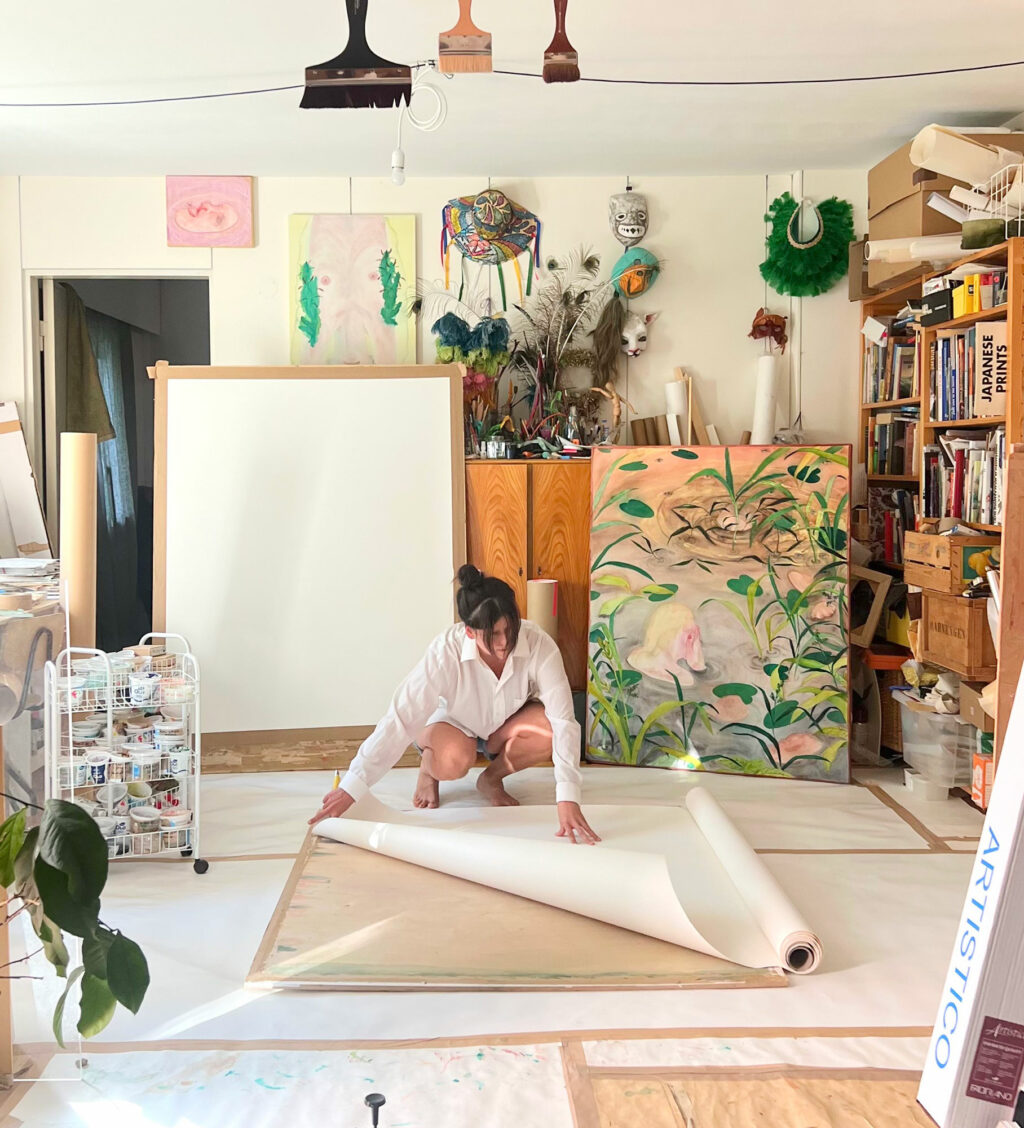
Shelters is grounded in the artistic practice of Juho Kanervo (b. 1985) and Sirkku Rosi (b. 1987), which involves somatic observation, as well as breathing and composing in situ in the forests of Pirkanmaa. Their project invites audiences to encounter the forest, raising awareness of biodiversity and the significance of local woodland ecosystems.
The works emerge from embodied experience and close attunement – they are, in essence, co-created with the forest. Through sensory engagement, it becomes possible to access forms of knowledge that cannot be reached through reason or sight alone. What does the forest – its flora and fauna – communicate? How does the forest feel, and how might such experience be expressed through painting or music?
Visually foregrounding embodiment, Sirkku Rosi works with watercolours, sculptural elements, and performative movement. The figures in her watercolour paintings appear to ooze sap and resin, while flora and fur thrive side by side. Juho Kanervo is an international musician whose primary instruments are the cello and bass; he composes spontaneously in response to his surroundings and in dialogue with the environment.
The project includes a live concert, which will take place on July 16 at 3:30 p.m. in the LemPi forest in Pirkanmaa. It will also be streamed live within the installation.
-
Eero Yrjölä and Aleksi Kolmonen’s collaborative installation weaves photography, ceramics, and sound into a multi-sensory exploration of the angel figure. Presented from a self-reflective, autobiographical perspective, the angel in the work is norm-defying, radical, and queer. The artists draw on traditional angelic imagery while simultaneously challenging the assumptions and worldviews it carries. Their angel is fluid, shifting from one form to another, moving between alternative realities. For the duo, connecting with one’s inner angel is a conscious practice: a way of encountering the world with innocence, openness, and without shame. In the installation, a porcelain angel figure is paired with its living, flesh-and-blood counterpart.
Eero Yrjölä (b. 1990) is a non-binary artist whose practice explores gender, sexuality, and personal growth. Working across diverse media with a focus on installation, their recent work has engaged with the materiality of clay.
Aleksi Kolmonen (b. 1996) is a community artist who creates constructed imagery and spaces for communal encounters, often at cultural events. He is a member of the Out’n Loud gay choir, founder and soloist of the gay orchestra Homoiskelmäorkesteri Harhavietti, and participates in community singing initiatives with the Rainbow Group.
-
The masamiracles collective, formed by dance artist Matti Haaponiemi and visual artist Sanna Saastamoinen, has been active since 2016. Their practice centres on the open-minded fusion of diverse forms of expression to create shared, immersive experiences. Their performances transport audiences to mystical borderlands, shifting between the familiar and the unknown.
As part of the Art Realm Biennial ‘26 masamiracles will present a multidisciplinary performance on June 17 at 3 p.m., combining electronic music, dance, and video synthesis. The artists aim to immerse audiences in a joy-filled musical journey and hypnotic movement, inviting everyone to participate and express themselves freely in the dance space.
In their sound work, masamiracles employs synthesisers and drum machines. In video, they use analogue video synthesisers, mixers, and feedback techniques to create dynamic, immersive visuals.
Artist groups
-
Impossible Instruments is a body of work that moves between music, visual art, and poetry. Its conceptual premise proposes that existing instruments are insufficient – that there are sounds, forms of music, and modes of playing for which no instruments yet exist.
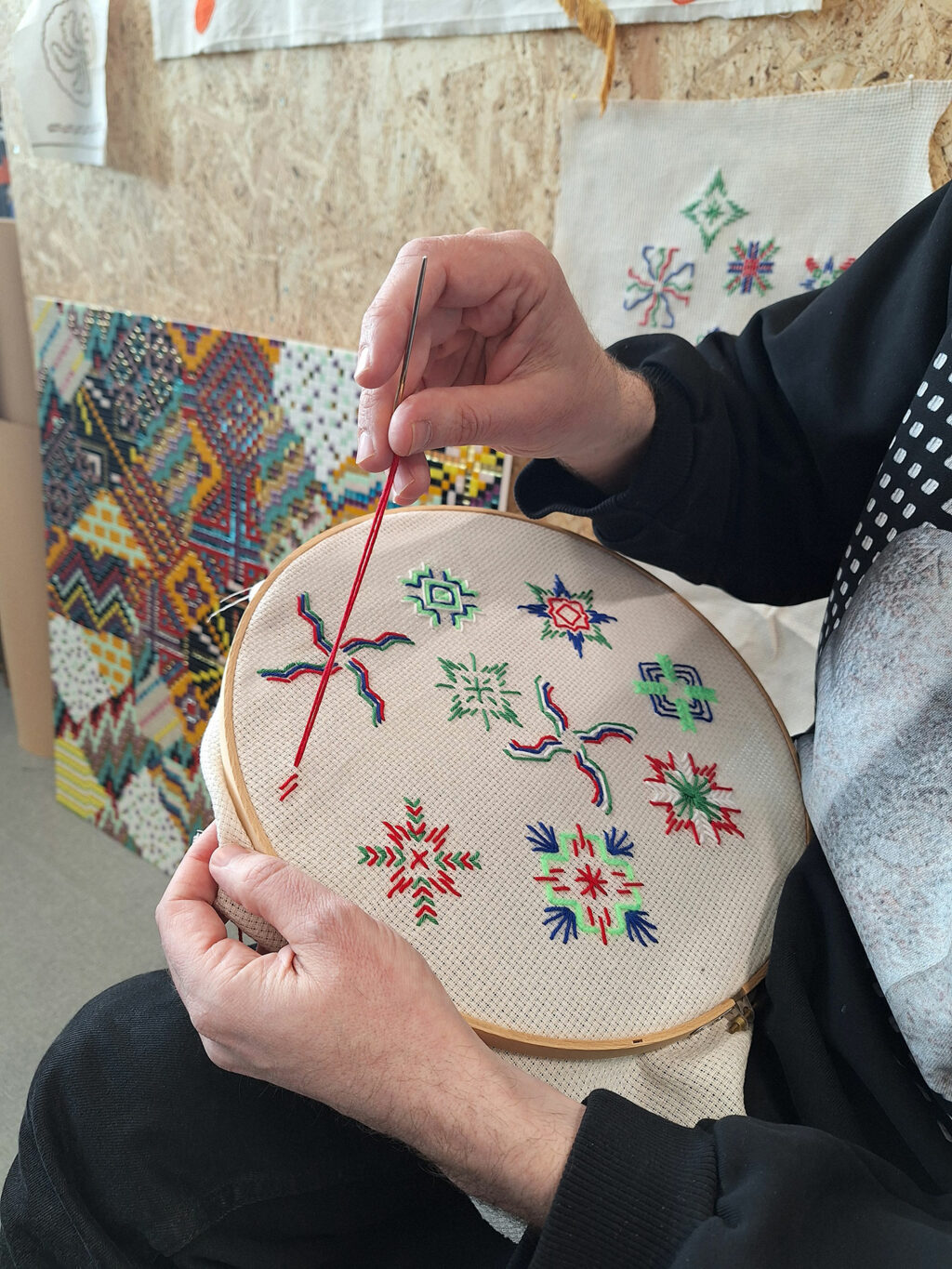
Myths and fiction abound with descriptions of instruments that have never existed in physical form. Can we attune our “mind’s ear” to hear something beyond the limits of auditory perception? Jan Anderzén (b. 1978) invited poets Pauliina Haasjoki, Sini Silver, and Henriikka Tavi – as well as his own child – to describe an impossible, imagined instrument in words. He then used these poetic texts as the basis for visualising speculative instruments.
Based in Tampere, Jan Anderzén works across multiple media and art forms, expanding the tradition of collage. He draws on cultural history and folklore that resonate with themes of contemporary relevance.
City space
-
Ilkka Virtanen (b. 1963) is a Kangasala-based sculptor renowned for his masterful handling of wood. His sculptural figures explore evolutionary processes and their fictional detours, often blending animal and plant features with human skeletal forms, inspired by ancient fossil finds that are neither purely plant nor animal. Through these works, Virtanen highlights the unpredictability of evolution: humans cannot foresee what the fossils of the future might look like. With the environment undergoing unprecedented change due to human intervention, the potential impact on evolutionary processes is unknowable. For Virtanen, evolution is not a distant or abstract concept – it is an event unfolding here and now.
Virtanen’s new work, Homo Nepenthes Mangrove, debuts as the summer sculpture on Tammerlampi Pond as part of the Art Realm Biennial ’26. Depicting a couple with their offspring, the sculptural group merges plant forms with human skeletal figures, creating an imaginative evolutionary hybrid – an entirely new species brought to life.
-
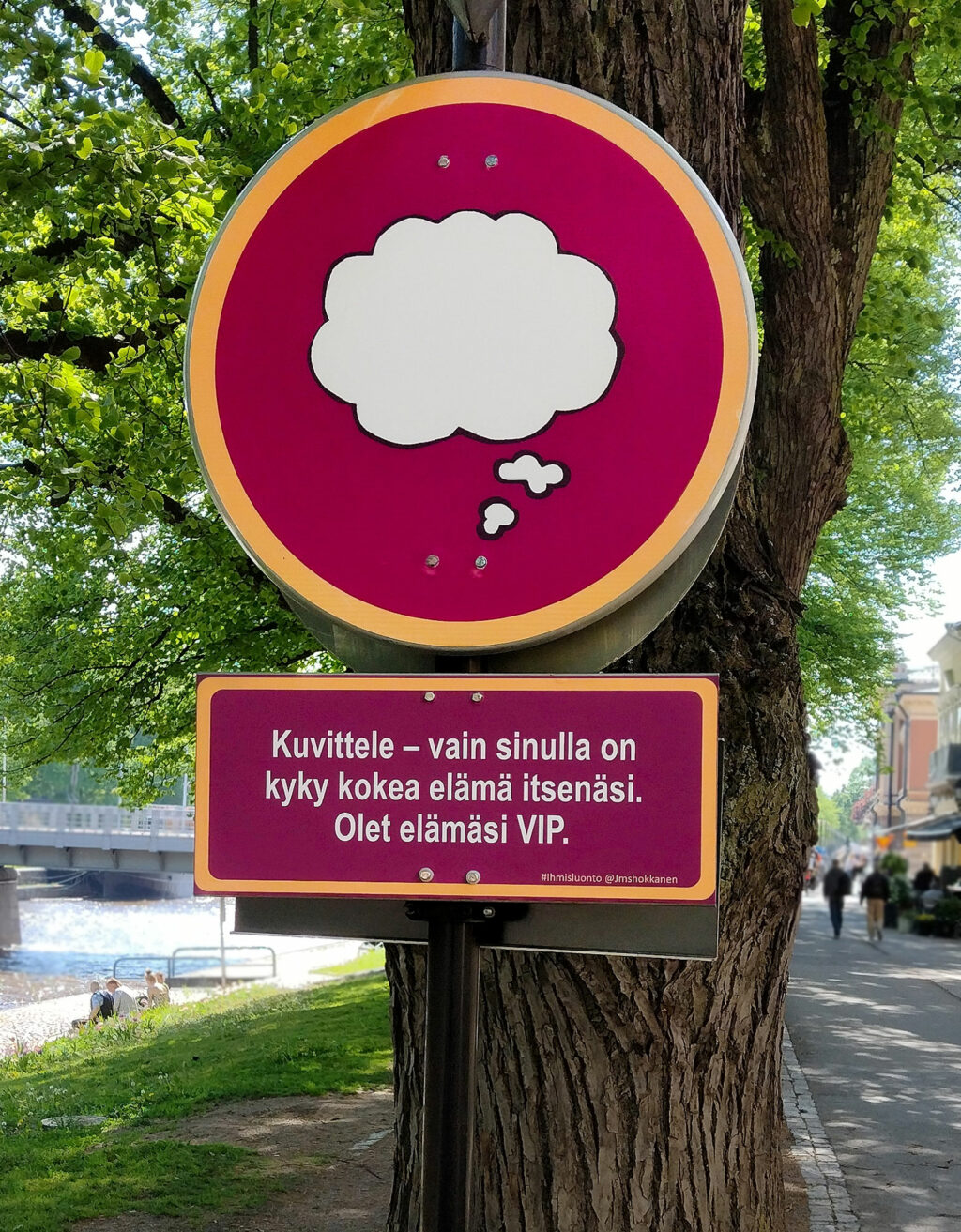
“Warning! My exhibition may contain hidden messages.”
Janne Hokkanen (b. 1983) is a Tampere-based artist whose practice is characterised by curiosity, a spirit of experimentation, and a surrealist sensibility. Moving fluidly between mediums, he combines art, science, and natural sciences to create works layered with multiple meanings. “Human nature is a constant subject of exploration for me; studying it offers insights into the complexity of human existence. Humour plays a central role in my life, and I will be sharing it with audiences this summer through sign-based works.”
In this participatory installation, Hokkanen reflects on social phenomena and lifestyle choices through a lens of critical reappraisal. He invites viewers to pause, offering a respite from the constant stream of images on mobile devices and encouraging engagement with one’s own thoughts. The signs were first presented in Hämeenpuisto Park in 2016. Their return at the Art Realm Biennial ‘26 this summer marks the tenth anniversary of Hokkanen’s sign project.
-
Jussi Lahtinen’s practice explores the city as a visual, cultural, and technological entity. He is particularly interested in how the built environment shapes human experience and how urban landscapes carry both collective and personal meaning. The city becomes both conceptual cue and stage, a site where reality, memory, and imagination collide and merge.
For his earlier Metropolis series, Lahtinen created a collection of imaginative urban imagery. In Urban AI Art, he then fed these images into an artificial intelligence programme, which generated endless new versions. In the current work, Urban AI Art “We”, the image stream comes alive with people and colour, continuously evolving without a fixed history. Each image is destroyed immediately after it appears, meaning that viewers encounter every moment only once.
NB! The work is on display in the Finlayson Area exhibition and on the tram stops until 28 June, but not in the foyer of Tampere City Hall as previously mentioned.
Lahtinen works across graphic design, digital art, and AI-driven processes. He approaches artificial intelligence not merely as a tool, but as a collaborative partner, using it to examine shifting notions of authorship, creativity, and the evolving role of the artist.